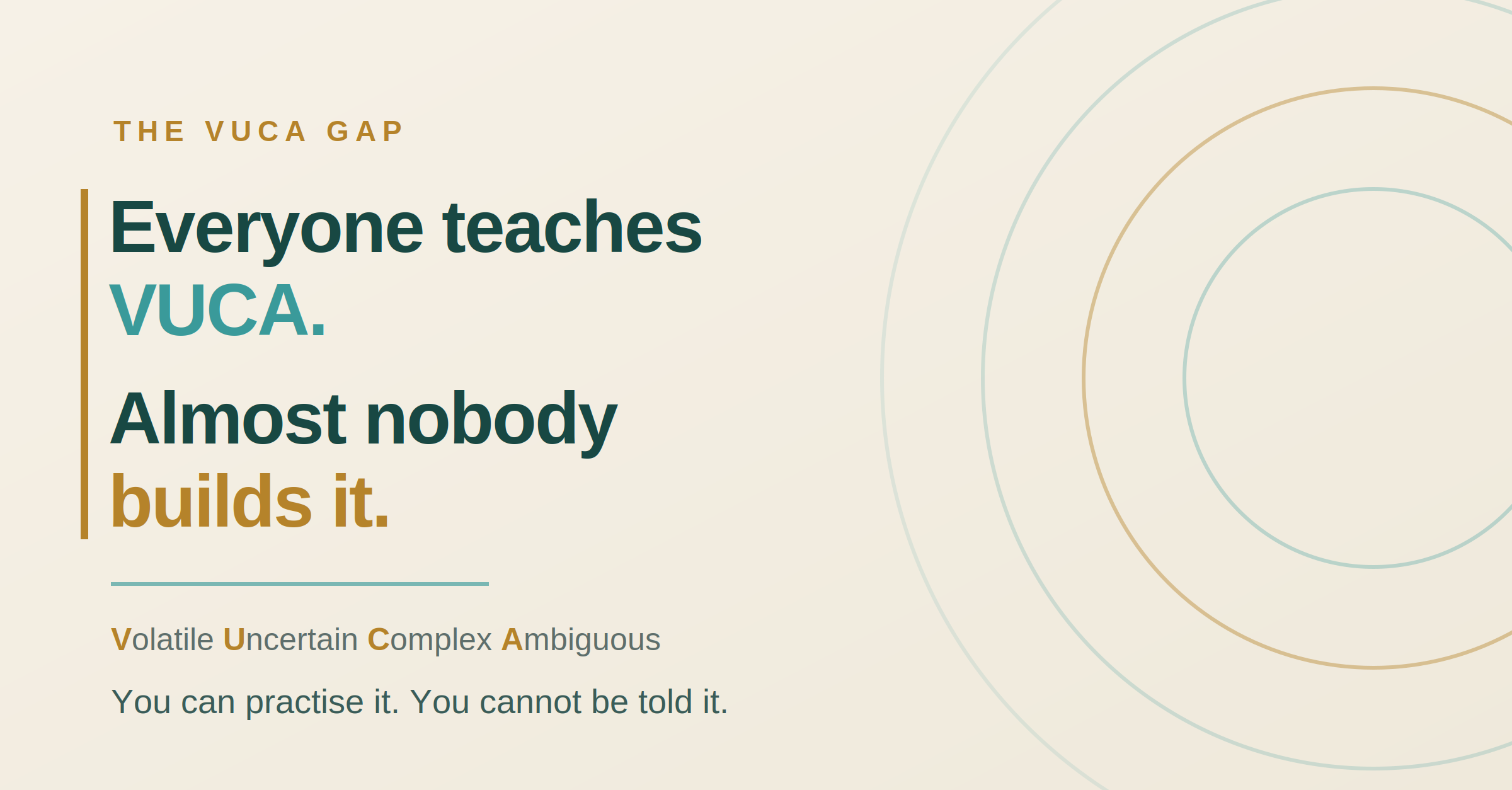
Walk into almost any senior leadership program and you will find VUCA somewhere on the agenda. Volatile, uncertain, complex, ambiguous. The term came out of the US military in the 1990s, crossed into business not long after, and by now it is so well travelled that most executives can recite the four words without thinking.
That is exactly the problem.
Content is not capability
We have spent twenty years getting comfortable talking about VUCA. We have not spent much time getting better at leading in it. Those are not the same skill. Knowing what the word means is content. Holding your nerve when the situation is genuinely unclear, when the data is thin, when reasonable people at your own table disagree about what is even happening, that is capability. Most organizations have plenty of the first and very little of the second.
I want to be precise about where the gap actually sits, because the usual diagnosis is wrong. The problem is not that nobody addresses uncertainty in leadership development. Plenty of programs do. Adaptive leadership, decision-making under pressure, resilience, it all shows up on agendas. The problem is the method. We keep trying to build a capability that only lives in ambiguity using formats that quietly remove the ambiguity.
The problem is the method
Think about how a typical case study works. Someone wrote it. That someone knows how it ends. The facilitator has a teaching note with the right insight already in it. Participants can feel this, even when nobody says it out loud. So the room does what rooms do. It reverse-engineers the answer the designer is looking for. Everyone goes home feeling sharper. Nobody has actually practised the thing that makes VUCA hard, which is committing to a call when no answer key exists and no one is going to confirm you got it right.
Real ambiguity has no teaching note. You move before the picture is clear, because waiting for clarity means waiting until the moment has passed. You hold two contradictory reads of the same situation at once without letting the discomfort push you into a premature decision just to feel settled. You tell your team the truth about what you do not know while still giving them something solid to stand on. None of that is knowledge you can transfer by explaining it. It is behaviour. And behaviour gets built by doing the thing, badly at first, often enough that it is available to you when it counts.
This is why the leaders who are genuinely good in turbulent conditions rarely got that way in a classroom. They got it the expensive way, through real situations with real consequences, usually a few they would rather forget. That works, but it is slow, it is unevenly distributed, and it tends to teach the lesson only after the cost has already been paid.
So the real question for anyone responsible for developing leaders is not whether your program mentions VUCA. It almost certainly does. The question is whether your people are getting reps. Are they making consequential calls inside situations that are actually unclear, where the outcome is not predetermined and nobody hands them the resolution at the end? Or are they being walked through tidy scenarios that were solved before they walked in the door?
What actually builds it
A few things separate the leaders who hold up in turbulence from the ones who only look good when conditions are stable.
They can act without certainty and stay open to being wrong. They decide on incomplete information and adjust as more arrives, rather than freezing until a clarity that is never coming finally shows up.
They are honest about what they do not know. They have learned that projecting false confidence is a short-term loan against trust, and the bill always comes due. So they name the uncertainty out loud and anchor their people in values and direction instead.
They treat each new mess as new. They resist the reflex to map today onto the last thing that looked like it, because in genuinely complex systems the surface resemblance is usually a trap.
And the best of them build this in their teams, not just in themselves, so the organization can absorb a shock without everything depending on one steady person at the top.
Here is the uncomfortable part. You cannot put any of that on a slide and expect it to land. You build it the way you build any hard skill, through deliberate practice in conditions that resemble the real thing closely enough to matter. For this capability, that means practice where the ambiguity is genuine. Where the situation is unclear. Where your choice has consequences that play out. And where, crucially, no one in the room already knows the right answer.
That is the bet behind the simulation work we do. Not workshops about uncertainty. Reps inside it.
If you are rethinking how your organization develops leaders for the conditions they actually face, this is the conversation I have most often, and the one most worth having: withimpact.com/simpact-live